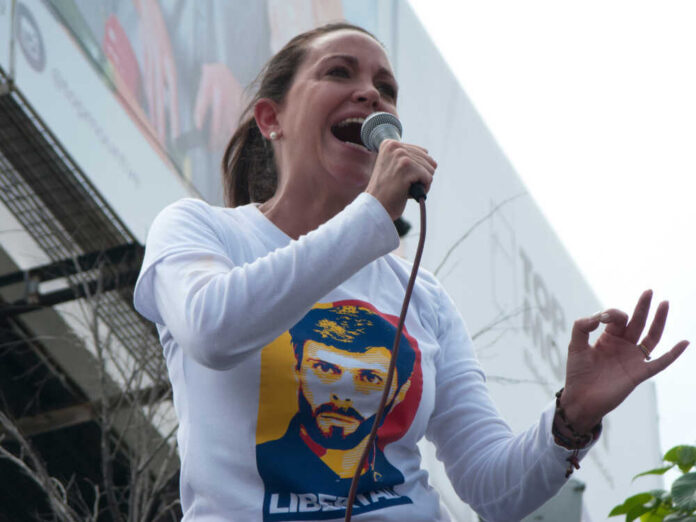
María Corina Machado stepped back onto Venezuelan soil after ten months away, and the country’s political calendar just changed.
Story Snapshot
- Machado returned to Venezuela after months in exile, following multiple blocked attempts.
- Her camp cites precinct tallies indicating her endorsed candidate won the 2024 election.
- Venezuelan officials previously denied blocking her, while United States officials rejected claims of U.S. interference.
- The Carter Center said the 2024 vote fell short of democratic standards and lacked full station results.
A return that reopens the vote fight
María Corina Machado’s return lands on top of a live electoral dispute. The opposition says precinct-level records show Edmundo González Urrutia, the candidate Machado backed, won by a wide margin. Their figures claim 67 percent for González and 30 percent for Nicolás Maduro. Venezuela’s National Electoral Council announced the opposite, awarding Maduro 51.2 percent and González 44.2 percent. That clash raises the stakes today, because it ties Machado’s presence to a claim of public mandate grounded in local tallies.
Her path home did not come easy. News outlets detailed attempts over months. Reports described three blocked entries within a single day in late September and difficulties with a route through Curaçao, including landing-permit denials. Her senior adviser, David Smolansky, told reporters that authorities interfered with her return three times in 24 hours. Venezuelan officials publicly denied they were stopping her, even as these incidents stacked up. The push and pull defined her exile’s endgame.
What Washington said, and what it did not
The United States weighed in on the question of her right to return. Secretary of State Marco Rubio stated plainly that Machado, a Venezuelan citizen, had every right to enter her country whenever she chose. He added that Washington wanted to guarantee her safety. Rubio also pushed back on rumors abroad by saying the United States had not asked any country to block anyone’s entry, drawing a clear line against claims of American pressure in the Caribbean or elsewhere.
That message matters because it removes one convenient scapegoat. When powerful countries are blamed for airport doors closing, local officials can dodge scrutiny. Rubio’s denial shifts focus back to the actors who control borders and tarmacs inside and around Venezuela. For readers who value clear accountability, that alignment tracks with common sense: if Washington says it did not make the call, then the next questions return to Caracas and its partners.
After more than 10 months in exile, Venezuelan opposition leader and Nobel laureate María Corina Machado has returned home.
"I am here. With you," Machado announced on X Sunday morning shortly before other members of the opposition confirmed her arrival without providing… pic.twitter.com/TGDEIErXrg
— CNN (@CNN) October 25, 2026
The missing building block: full transparency of results
The Carter Center, which observed the 2024 race, said the election did not meet international standards and could not be considered democratic. Its reporting flagged a core problem: the National Electoral Council did not publish polling-station-level results. Without that level of data, outside parties cannot check the official totals or compare them to the opposition’s precinct images and records. That hole in the public record keeps the contest of numbers alive, long after voters cast their ballots.
Machado’s mandate story runs through González’s tally, not her own ballot count. She endorsed him after she was barred, and the opposition’s claim rests on copies of local acts gathered by their monitors. That is a strong narrative if the dataset is complete and verifiable, and weaker if the government’s official figures stay locked away. Either way, her return makes publishing full station results not just good practice but necessary for national trust.
Why her arrival now matters on the ground
Opposition organizers expect her presence to boost street energy, donor focus, and coordination. Her critics plan to cast her as a spoiler to order. Both sides understand the symbolism: a leader leaves, tries and fails to get back, and finally sets foot at home. That sequence brings attention, and attention attracts pressure. If authorities keep denying obstruction while airports or borders slow-walk her team, the public will measure words against outcomes in real time.
Policy minds should watch three levers. First, whether aviation and immigration officials treat her as barred or as a normal citizen. Second, whether opposition groups present a complete archive of precinct documents for outside audits. Third, whether the state releases station-level results so the two ledgers can be compared. Those steps are simple in theory and decisive in practice. They turn accusations into records and slogans into math, which is how political quarrels end.
Sources:
youtube.com, inquirer.com, congress.gov, efe.com, elcolombiano.com, kansas.com