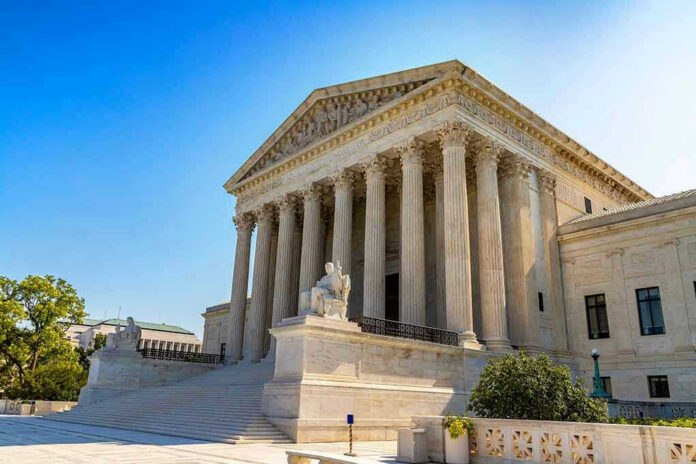
The Supreme Court has effectively opened the door for President Trump’s Justice Department to erase Steve Bannon’s contempt conviction—after he already served prison time—setting off a fresh fight over whether Washington enforces the law evenly or politically.
Quick Take
- The Trump DOJ asked a federal judge in Washington, D.C., to dismiss Bannon’s 2022 contempt of Congress conviction tied to the defunct Jan. 6 House committee.
- The move could not only wipe out the conviction but also the lower-court rulings that upheld it, potentially mooting Bannon’s pending Supreme Court appeal.
- Bannon already served a four-month sentence in 2024, making the dismissal effort unusual because it targets a completed punishment.
- Judge Carl Nichols must decide whether to grant the DOJ motion, a decision that could shape how future congressional subpoenas are enforced.
DOJ Seeks to Vacate a High-Profile Conviction After the Sentence Was Served
The Justice Department, now operating under the Trump administration’s second term, moved in February 2026 to dismiss Steve Bannon’s contempt of Congress conviction for defying a subpoena from the House Select Committee that investigated January 6.
Solicitor General John Sauer told the Supreme Court the government believes dismissal would serve the “interests of justice,” and the department filed its request in federal district court in Washington, D.C.
Bannon gets Supreme Court help in erasing contempt charges
The Trump administration said it was seeking to dismiss Bannon’s contempt charges “in the interests of justice.” @CourthouseNews https://t.co/MXsnaq9fs0
— Kelsey Reichmann (@KelseyReichmann) April 6, 2026
The procedural posture is a big part of why the story matters. Bannon was convicted in 2022, appealed, and ultimately served roughly four months in 2024 after the courts refused to block the sentence while his appeal continued.
The new DOJ filing aims to eliminate the conviction anyway, which could also undercut the appellate rulings that previously affirmed it and end the Supreme Court case without a final merits decision.
What the Contempt Charge Was—and Why Courts Rejected Bannon’s Defenses
Bannon’s case arose from a standard legal tool in congressional oversight: the subpoena. The January 6 committee demanded documents and testimony in October 2021.
Prosecutors later argued he willfully refused to comply, and the government indicted him for contempt of Congress under a statute that criminalizes defying a lawful congressional subpoena and allows for jail time and fines. A jury convicted Bannon on two counts at trial.
At trial and on appeal, key defenses faced major legal headwinds. Public reporting and legal analysis around the case emphasized that claims like “advice of counsel” generally do not excuse deliberate noncompliance in this context, and courts had rejected the idea that Bannon could refuse outright based on executive-privilege arguments as presented.
That matters because the DOJ’s current dismissal push does not hinge on newly surfaced evidence in the public record cited here, but rather on prosecutorial discretion.
The Supreme Court’s Role: Clearing a Path Without Deciding the Merits
Headlines describing the Supreme Court “clearing the way” can be easy to misread. The Supreme Court did not hold a full hearing and declare Bannon innocent. Instead, the practical effect stems from the DOJ’s decision to change course while the case is still pending in court.
If the trial judge grants dismissal, the Supreme Court appeal could become moot, and the justices may never issue a definitive ruling on the underlying legal questions.
That dynamic highlights a broader reality Americans across the political spectrum have grown tired of: outcomes can hinge less on consistent standards and more on which party controls the executive branch. Conservatives who spent years arguing the DOJ was “weaponized” under prior leadership may see a correction.
Liberals who saw the prosecution as accountability may see selective favoritism. The public record available here supports one clear point: discretion, not a new trial verdict, is the lever being pulled.
Why the Decision Could Reshape Congressional Oversight—and Public Trust
Judge Carl Nichols will decide whether to approve the DOJ request to dismiss. If granted, the result would be more than symbolic. It could weaken the practical force of congressional subpoenas when targets believe elections can later change the government’s appetite to prosecute.
It also places future committees—Republican or Democrat—on notice that contempt referrals may not be durable across administrations, raising the stakes for negotiated compliance rather than courtroom showdowns.
The longer-term effect is harder to measure, and the available research does not provide polling or detailed internal DOJ reasoning beyond the “interests of justice” language. Still, the pattern is legible: in politically charged cases tied to Washington’s biggest narratives, legal finality can be elusive.
For voters who already believe the system protects insiders and punishes regular people, the idea of erasing a conviction after a sentence has been served will likely deepen the sense that the rules change depending on who holds power.