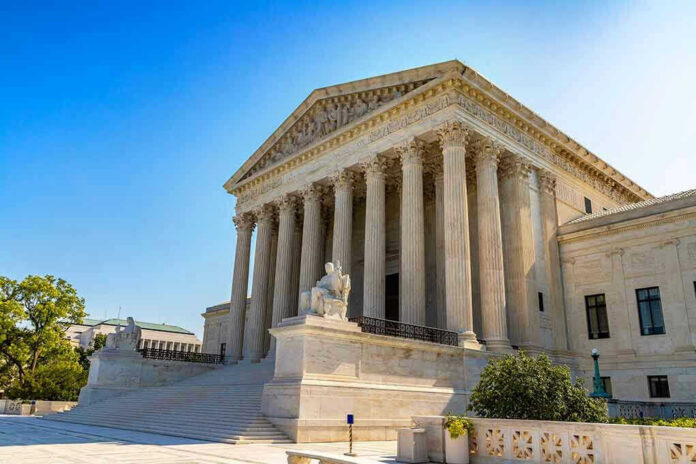
The Supreme Court’s new term that started today will determine the fate of key Trump administration policies while simultaneously ruling on contentious social issues that could reshape American law for generations.
Story Overview
- The Supreme Court begins its October 2025 term today, reviewing Trump-era policies and major social issues.
- Trump’s Executive Order 14231 addresses northern border drug enforcement among policies under review.
- Conservative justices are positioned to uphold constitutional principles and executive authority.
- Social issue cases could reverse years of leftist judicial activism.
Supreme Court Poised to Restore Constitutional Order
The Supreme Court commenced its October 2025 term with a docket that represents a potential turning point for American jurisprudence. After years of watching lower courts block conservative policies and advance progressive agendas, constitutional conservatives now have reason for cautious optimism.
The Court’s current composition suggests that Trump administration policies will receive fair judicial review, unlike the obstruction witnessed during previous years when activist judges routinely issued nationwide injunctions against common-sense immigration and security measures.
This term arrives at a crucial moment when Americans desperately need the judiciary to function as intended by the Founders rather than as a super-legislature advancing leftist social engineering. The cases before the Court represent an opportunity to restore the proper balance between federal authority, state rights, and individual liberties that the previous administration systematically undermined.
Border Security Policies Face Judicial Scrutiny
Among the Trump policies under review is Executive Order 14231, issued March 6, 2025, which addresses the flow of illicit drugs across America’s northern border. This executive action demonstrates Trump’s commitment to securing all of our borders, not just the southern frontier that received most attention during his previous term. The order represents a comprehensive approach to drug enforcement that recognizes the reality of cross-border criminal networks.
Legal challenges to this and similar border security measures reflect the left’s continued inability to accept that national sovereignty includes controlling who and what enters our country.
These lawsuits typically originate from sanctuary jurisdictions and open-borders advocacy groups that prioritize illegal immigrant rights over American citizen safety. The Supreme Court’s review provides an opportunity to establish presidential authority over immigration enforcement and border security definitively.
Social Issues Return to Constitutional Foundation
The social issues component of this term’s docket offers hope for reversing decades of judicial overreach that imposed radical social policies without democratic input. Previous Supreme Court terms demonstrated how unelected judges usurped legislative authority to advance progressive causes that most Americans never voted for. Conservative legal scholars have long argued that many controversial social policies lack constitutional foundation and should return to state and local democratic processes.
These cases arrive as families across America struggle with the consequences of woke ideology in schools, workplaces, and communities. Parents have watched helplessly as their children faced indoctrination rather than education, while employers navigated increasingly complex and often contradictory mandates regarding speech, religious liberty, and biological reality. The Court’s decisions could restore sanity to public policy by reaffirming constitutional limits on government power.
Opportunity to Reverse Leftist Judicial Activism
This Supreme Court term represents more than routine case review; it offers a chance to correct years of judicial activism that violated separation of powers principles. During the Biden administration, federal courts consistently overstepped constitutional boundaries by creating policy rather than interpreting law. Lower court judges issued sweeping injunctions based on personal political preferences rather than legal precedent or constitutional text.
Conservative Americans have waited patiently for the judiciary to return to its proper constitutional role. The Court’s current composition suggests that originalist interpretation may finally prevail over the living constitution theory that allowed progressive judges to discover new rights while ignoring enumerated ones. This shift could restore confidence in judicial institutions by demonstrating that courts follow law rather than political fashion.
Stakes Extend Beyond Individual Cases
The broader implications of this term extend far beyond specific policy disputes. American constitutional government depends on each branch operating within defined limits while respecting the others’ legitimate authority. When courts routinely override executive decisions based on policy preferences rather than legal analysis, they undermine democratic governance and constitutional separation of powers.
These cases also test whether the legal system will acknowledge obvious realities that the previous administration ignored. Common sense principles regarding border security, biological sex, parental rights, and religious liberty faced constant attack from progressive activists who used federal courts to impose their agenda. The Supreme Court’s willingness to defend these foundational concepts will determine whether American law remains grounded in truth and constitutional text or continues drifting toward ideological extremism.
Sources:
Holland & Knight – Trump’s 2025 Executive Orders Chart