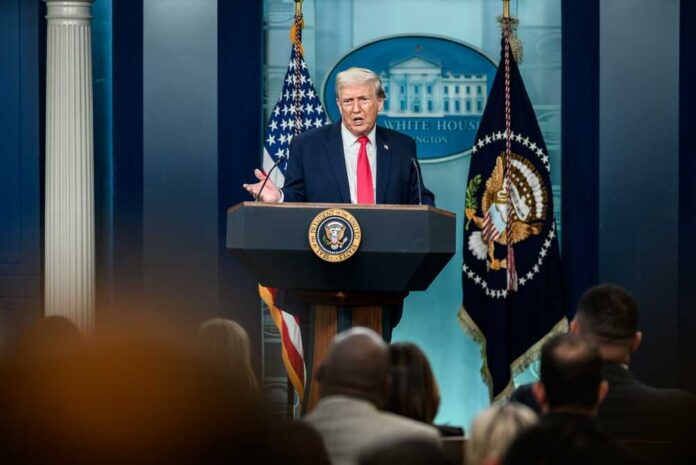
President Trump put a clear price on exposing fraud: a promised cut for the citizen who helps recover taxpayer money.
Story Snapshot
- Trump announced a Fraud Whistleblower Incentive Program with a 1% reward promise.
- The plan targets fraud against taxpayers and federally funded programs via fraud.gov tips.
- Any American, including journalists with outlet approval, can submit tips.
- The White House described a $25 million program, with the Justice Department involvement.
Trump’s Offer: A Commission for Catching Fraud
President Trump announced a Fraud Whistleblower Incentive Program and said tipsters could earn a 1% commission when their information helps the government recover stolen taxpayer dollars. He named eye-popping examples: $1 billion or $10 billion uncovered would mean a major payday for the citizen who sparked the recovery. He tied the offer to stopping waste in federal programs and urged ordinary Americans to report fraud through fraud.gov, positioning the public as force multipliers.
Trump said the program welcomes “independent journalists, and everybody, and all Americans,” and added that reporters could participate if their news organizations approve. That inclusion signals a wider net than many government tip lines. It blends citizen-sourced leads with on-the-ground reporting that can surface complex schemes. The design aims to turn private knowledge into public enforcement power, with a promise that the person who sparks a recovery shares directly in the win.
How The Program Will Work, As Described
Reports describe a federal reporting channel at fraud.gov, where the government will intake tips aimed at fraud against U.S. taxpayers and federally funded programs. White House descriptions outlined a $25 million initiative with the Department of Justice as the administering agency, giving the program a central hub for processing and action. Trump highlighted speed and results, saying the payment would depend on money recovered by the government, not just allegations on paper.
At the event, a named recipient offered a first glimpse of activity. Conservative video creator Nick Shirley received a $10,000 award, billed as the first payout tied to the new initiative. That check served as a proof-of-concept moment for supporters who see bounties as catalysts. It showed the administration’s intent to move from talk to checks. It also underscored the message that citizens who help stop theft of tax dollars will not be left clapping from the sidelines.
The Fine Print Tension: 1% Promise vs. Posted Caps
Coverage highlighted a tension between Trump’s 1% commission promise and other public materials that referenced awards up to $30,000 and triggers tied to charges or convictions. Trump later said criminal charges were not required and framed payment around actual recoveries. These mixed signals matter because the size and timing of awards shape behavior. Clear rules are the backbone of any bounty system; citizens will act faster when the target and the tape are easy to see.
Reports also said Trump would decide who is “deserving,” even serving as an arbitrator for disputes. That stance places presidential judgment at the center of awards. Supporters may see this as cutting delays. Critics of process might prefer published standards and an appeals path. Conservative common sense leans toward two guardrails at once: real rewards for real recoveries, and rules that any honest person can understand before they hit submit.
Why Paying for Tips Fits American Practice
Contingent rewards have long helped the government reclaim stolen funds. The False Claims Act lets private citizens sue on the government’s behalf and share in recoveries. From 1987 to 2005, whistleblower-filed cases generated about $9.6 billion of more than $15 billion in total recoveries, showing how private leads drive public wins. Securities regulators also pay for tips that lead to successful actions, further proving that smart incentives reveal hidden misconduct.
BREAKING: 🇺🇸 President Trump unveils a $25 million Fraud Whistleblower Incentive Program that pays tipsters a 1% commission on fraud they help uncover.
If you report $1 billion worth of fraud, you get $10 million.
Trump says there's no limit on the payout. pic.twitter.com/KRkK4mGOro
— Futures Max (@FuturesMax) October 21, 2026
This new program borrows that logic and aims it at broad taxpayer fraud. The 1% framing is simple enough to remember, which is why it resonates in living rooms and workplaces. But programs endure when the math, triggers, and decision process match the headline. The fastest path to durable results is straightforward: define eligible fraud, tie rewards to verified recoveries, publish the claim steps, and pay promptly when citizens help claw money back.
Sources:
cbsnews.com, inquirer.com, washingtonexaminer.com, thegatewaypundit.com, usatoday.com, yahoo.com