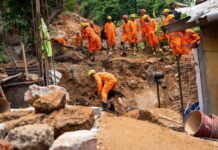
Three firefighters died in a sudden wall of flame on the Colorado‑Utah border, and the hardest questions are about why it keeps happening the same way.
Story Snapshot
- Three wildland firefighters were killed and two injured in a burnover during the Snyder fire complex.
- Lightning‑sparked fires merged into a fast‑moving 28,000‑acre blaze with zero containment and thin details on what went wrong.
- Officials praise bravery and declare emergencies, while specific tactical failures and safety lessons stay mostly out of public view.
- This tragedy fits a long pattern of firefighter entrapments where the “burnover” label arrives faster than hard answers.
What Happened On The Line That Saturday
Three firefighters were killed and two more were burned on Saturday while tackling wildfires along the Colorado‑Utah border, according to the United States Wildland Fire Service.[3] The crew was working the Knowles and Gore fires on the Colorado side when fast‑moving flames overran them in what officials called a burnover.
Reports say the injured firefighters are in the hospital with burn injuries, but their conditions and exact treatment details are still not public.[2] Families, coworkers, and the wider fire community now wait for names and fuller accounts.
Those fires did not start as one giant blaze. Lightning strikes in eastern Utah’s Grand County ignited the Snyder Mesa and Jones fires, which then spread into Colorado and linked up with the Knowles and Gore fires.[1]
By Saturday evening, officials said the fires had merged into what some outlets call the Snyder Fire or Snyder Mesa Complex, burning about 28,000 acres with zero containment.[1] Pre‑evacuation warnings and road closures hit smaller communities in Mesa County as crews tried to stay ahead of shifting winds and steep terrain.[1]
Bravery, Emergency Declarations, And The Missing Details
The United States Wildland Fire Service publicly praised the crew’s bravery, dedication, and sacrifice, and promised support for the families.[2] Colorado Governor Jared Polis declared a disaster emergency, authorized the Colorado National Guard, and highlighted the threat to homes and ranches as the fire pushed across the border.[1]
Those steps fit the usual pattern: honor the fallen, surge resources, stress the scale of the crisis. What has not arrived yet are clear explanations of the tactical choices, equipment status, and real‑time wind data at the moment the burnover occurred.
A procession on Sunday honored the three firefighters who lost their lives while battling the Snyder Fire, a wildfire burning along the Utah-Colorado border. Officials said two other firefighters remained hospitalized with burn injuries. pic.twitter.com/Bc1sAbrUwE
— Breaking911 (@Breaking911) June 29, 2026
Officials have said only that the incident was a burnover, meaning firefighters were suddenly trapped as fire behavior changed and their planned escape routes or safety zones no longer worked.[15] That term carries weight. It can imply that the crew did everything they could and still got caught, or it can hide real questions about whether they ever had a safe route in the first place.
Right now, basic facts are missing from public view: wind speed at the entrapment site, slope and fuel type where they were working, and whether radios, engines, or fire shelters performed as expected.[3]
Why This Fits A Troubling Long‑Term Pattern
This tragedy does not stand alone. A review of wildland firefighter entrapments in the United States shows a repeated pattern: crews die or are burned when fast fire growth cuts off escape routes, and agencies quickly label the event as an entrapment or burnover.[18]
Investigators later map terrain, fuel, and travel routes, but those details rarely reach the public in a clear way.[14] Since the 1994 South Canyon Fire, where 14 firefighters died on a Colorado hillside, these events have kept happening with grim regularity.[6]
Best‑practice guides for entrapment investigations say law enforcement should lock down the scene, critical incident stress teams should debrief survivors within 24 hours, and specialists should document everything from burn patterns to damaged gear.[14] That means agencies know how to gather the truth.
The question is how much of that truth they share. When every major outlet repeats “burnover” and moves on to the broader wildfire crisis, ordinary people never see whether escape routes were truly viable or whether command pushed crews too far for too little gain.[3]
Accountability, Risk, And What A Common-Sense Lens Sees
Americans honor personal courage and demand accountability when officials fail at their basic duties. Through that lens, wildland firefighters look a lot like deployed soldiers: volunteers who accept risk, but who have a right to leaders that do not waste their lives.
When three firefighters die with thin public detail, people who value common sense start to ask if the system learned anything from past entrapments or if bureaucracies simply absorb the loss and press on.[6]
🚨 BREAKING: Three firefighters are dead after battling a wildfire along the Utah-Colorado border.
Officials say three wildland firefighters were killed while fighting the rapidly growing #SnyderFire. Two other firefighters were seriously injured and transported to the hospital… pic.twitter.com/Sdz47r50Lg
— Chase Thomason (@ChaseThomason) June 28, 2026
The scale of the West’s wildfire problem is real. Utah officials report more than 200,000 acres burning statewide, with the Cottonwood fire alone racing past 90,000 acres.[2] Drought, high winds, and thick fuels raise the stakes for every crew. But a large crisis does not excuse poor safety on any single fire.
The danger is that leaders lean on sweeping phrases like “historic conditions” and “unprecedented fire behavior” to dodge hard questions about whether line supervisors had the latest weather, whether they enforced safety zones, and whether anyone had the courage to pull back when conditions turned ugly.[18]
What Needs To Happen After The Headlines Fade
Once the immediate shock passes, a serious safety investigation should ask clear questions. Did the crew have more than one escape route, and did those routes stay open as the fire shifted?[15]
Were they working too close to unburned fuel during a wind change? Did pressure from politics or public fear of evacuation orders keep people on the line longer than common sense allowed? These are not accusations; they are the baseline questions any citizen should expect investigators to address after three deaths.
Real change will not come from another solemn press release or even another emergency declaration. It will come if agencies publish the full entrapment reports, not just soothing summaries, and bake the lessons into training and policy.[16] It will come if taxpayers and lawmakers insist that honoring firefighter sacrifice includes demanding clear answers about why they died.
Fire will always be dangerous. But when burnovers keep following the same script, the honest question is no longer “How did this happen?” It is “Why are we still letting it happen this way?”
Sources:
[1] Web – 3 firefighters killed, 2 injured while tackling wildfires on the …
[2] Web – Three Firefighters Killed, 2 Injured in Snyder Wildfire on Utah …
[3] Web – 3 firefighters killed responding to Snyder wildfire on Utah-Colorado …
[6] Web – Three firefighters killed, 2 injured in Snyder wildfire on Utah …
[14] Web – Three firefighters killed while tackling major wildfires along …
[15] Web – [PDF] Investigating Wildland Fire Entrapments
[16] Web – [PDF] Wildland firefighter entrapment avoidance: modelling evacuation …
[18] Web – Predicting Firefighter Injury and Entrapment in Urban … – PMC – NIH