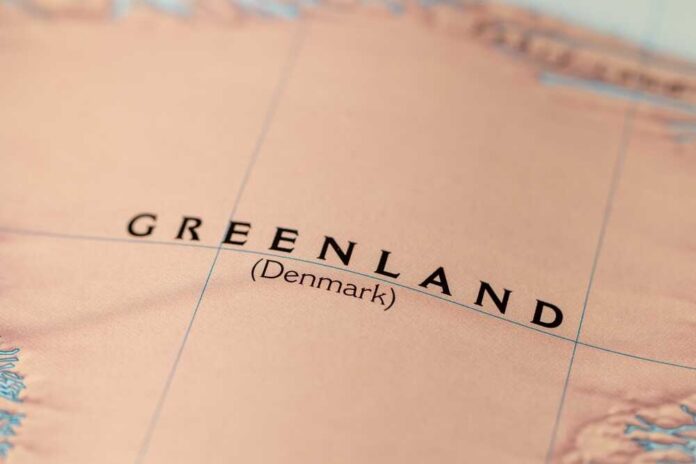
Washington just locked a front-row seat to the Arctic by expanding U.S. control over Greenland’s security.
Story Snapshot
- The United States, Denmark, and Greenland announced a new security deal expanding U.S. military access and rights in Greenland.
- President Trump said the agreement grants U.S. forces permanent access, basing, and overflight rights.
- Danish and Greenlandic leaders backed the deal, saying sovereignty remains intact.
- The pact blocks adversary bases and screens sensitive investments tied to China and Russia, officials said.
What Was Agreed And Why It Matters
The United States, Denmark, and Greenland said they reached a security agreement that expands U.S. military access on the island. President Trump announced the pact and framed it as permanent control over Greenland’s security. A United States State Department official described permanent access, basing, and overflight rights as core terms.
The practical effect is simple but strategic: America can move people and gear faster across the Arctic, where the shortest flight path to North America and Europe crosses Greenland’s skies.
The deal also aims at blocking rivals from gaining a foothold near the North American homeland. Reporting said the agreement prevents non-North Atlantic Treaty Organization countries from building bases and restricts sensitive investments, a clear message to China and Russia. Senator Marco Rubio praised the pact as a lasting fix to national security concerns in the Arctic.
Denmark’s government said it would sign the agreement during the United Nations General Assembly and then complete the necessary parliamentary steps before it takes full effect.
Sovereignty Assurances From Copenhagen And Nuuk
Danish Prime Minister Mette Frederiksen and Greenland’s leadership endorsed the arrangement and said it protects, not erases, Greenland’s status. Denmark stated sovereignty over Greenland would not be compromised, and officials highlighted Greenlanders’ right to self-determination.
That stance tracks with decades of practice. The United States has operated on the island since World War II under defense pacts that enabled base rights while keeping Danish and Greenlandic authority intact. The new deal fits that pattern, even as it widens American reach.
US to open two Cold War-era military bases in Greenland as Trump celebrates landmark deal for 'permanent control' over security of territory https://t.co/wwAnOoEpsA
— Daily Mail (@DailyMail) September 22, 2026
Political language can sound sweeping, but allied leaders pointed to legal guardrails. President Trump’s public framing stressed permanence and control, while Copenhagen and Nuuk underscored constitutional order and consent.
Those points are not opposites when seen through alliance logic: Denmark invites American power to deter threats; the United States accepts host-nation sovereignty while hardening a shared shield.
What Changes On The Ground In Greenland
Officials said the agreement allows permanent basing and overflight rights and may enable additional military construction to support Arctic missions. The island already hosts the Pituffik Space Base, a keystone site for missile warning and space tracking.
During the Cold War, the United States operated as many as 17 facilities in Greenland, then drew down as threats eased. Today’s shift moves the needle back toward readiness in a harsher world, where ice melts, sea lanes open, and cruise missiles fly longer ranges across polar routes.
US President Donald Trump is moving from his earlier ambition of acquiring Greenland to a security arrangement that would significantly expand the US military footprint on the Arctic island.
Here's what the deal is about 👇https://t.co/ru1c5Qc3CX
— Mint (@livemint) September 22, 2026
Expect more logistics hubs, runway upgrades, fuel storage, and radar or communications nodes to support patrols and lift. Expect tighter screening of outside money touching dual-use ports, minerals, or telecom.
The ban on adversary bases and curbs on sensitive investment serve a blunt goal: keep the Arctic flank free of Beijing’s leverage and Moscow’s forward sensors. That is not empire. It is a home-defense layout that starts farther from home, where response time decides outcomes.
The Arctic Chessboard, Explained Fast
Greenland sits on the great circle routes between North America and Europe. Submarines, bombers, and satellites care about that geometry. So do cargo planes and undersea cables.
The 1951 U.S.–Danish defense agreement and later updates built a legal bridge for American forces to guard that space, with Danish approval and Greenlandic involvement. This new pact updates the posture for present risks. It tells allies the United States will arrive quickly. It tells rivals to stay out or stay far back.
Sources:
nypost.com, reuters.com, nbcnews.com, aljazeera.com, npr.org, politico.com, euronews.com, goodmorningamerica.com, nsarchive.gwu.edu