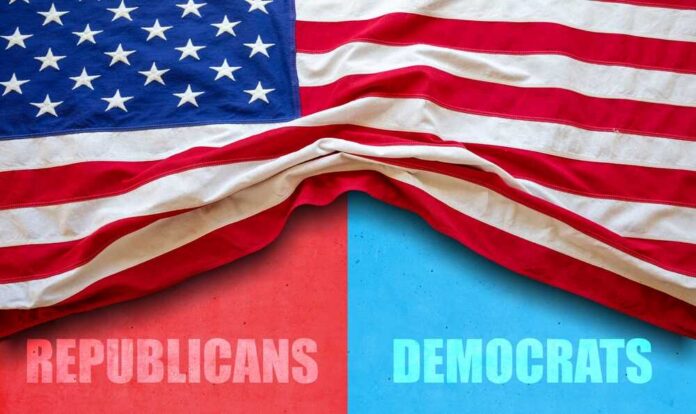
Gallup’s newest quarterly trend shows Democrats at 50% and Republicans at 39% when leaners are included, the widest Democratic edge since early 2009.
Story Snapshot
- Gallup’s latest quarter shows 50% Democratic/Democratic-leaning vs. 39% Republican/Republican-leaning.
- The gap is the largest Democratic advantage since the first quarter of 2009.
- Gallup’s long-running series confirms the 2009 high-water mark and comparable method over time.
- Recent gains stem mainly from independents leaning Democratic, not a surge in strong identifiers.
What Gallup Measured And Why It Matters
Gallup asks Americans their party, then asks independents which party they lean toward. The newest quarter shows 50% identify as Democrats or lean Democratic, while 39% identify as Republicans or lean Republican, a double-digit gap that grabs attention. The method has decades of consistent use, so the figures sit in a stable trend line rather than a one-off snapshot. That makes the historical comparison to earlier peaks, especially 2009, more meaningful and easier to trust.
Quarterly party identification is not a vote forecast. It signals mood and broad alignment. Campaigns watch it because leaners often behave like partisans in general elections. Gallup’s own notes say recent movement mainly came from independents shifting their lean, not from a mass switch among core party loyalists. That pattern suggests the public is reacting to current events and leadership rather than undergoing a deep, permanent realignment of base voters.
How This Compares To The 2009 High-Water Mark
Gallup’s historical tables show the first quarter of 2009 produced one of the largest Democratic edges since the series began, with Democrats and leaners over Republicans and leaners by double digits. The newest quarter reaches a similar spread, marking the widest advantage since that time. The comparison matters because it ties today’s gap to moments of strong Democratic momentum, while still using the same leaned-party framework that Gallup applies across years.
Gallup’s trend also shows swings over time, including periods when Republicans held an edge as recently as 2024, before Democrats regained ground in 2025. The firm reported 46% Democrats or leaners versus 43% Republicans or leaners in the second quarter of 2025, showing the direction of travel before the latest jump. The new 50% to 39% reading, as summarized in coverage, lands as a larger extension of that turn toward Democrats.
Why Leaners Drive Big Headlines
Leaners matter because they shift faster than strong partisans. When independents lean more Democratic, the headline number grows even if the share of self-identified Democrats barely moves. Gallup has repeatedly explained this sequence: ask party, then ask independents which party they lean toward, then report both “identifiers only” and “identifiers plus leaners.” The latter yields the big top-line that dominates coverage and historical comparisons.
New – Party identification poll
🔵 Democratic 50%
🔴 Republican 39%New Record high for Democrats
Gallup #B – A – Q3 2026
— Political Polls (@PpollingNumbers) October 5, 2026
Conservative readers should focus on what this signal is and is not. It indicates a national mood giving Democrats a current edge. It does not guarantee turnout or wins in close states. Smart strategy treats it as a warning light, not a verdict. Ground work, candidate quality, local issues, and the economy still decide many races. But dismissing a durable Gallup trend would ignore evidence that independents are tilting, which often shapes the final map.
Sources:
newsweek.com, news.gallup.com, ground.news, independent.co.uk