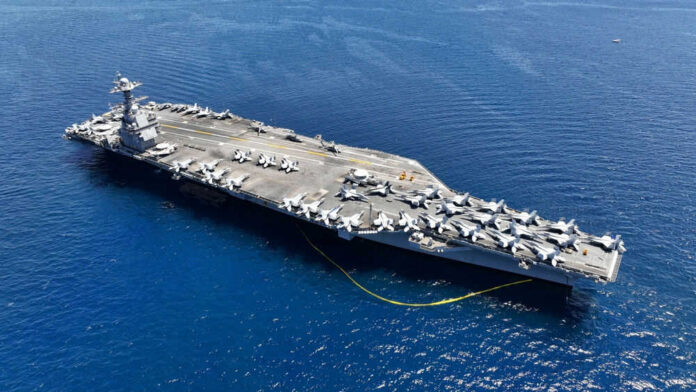
A third US aircraft carrier has now joined the Navy’s buildup near Iran, pushing American firepower in the region to a scale rarely seen outside wartime.
Story Snapshot
- The USS Theodore Roosevelt entered the US Central Command region on November 15, joining the USS George H.W. Bush and USS George Washington.
- The carrier left San Diego in September with the USS Makin Island amphibious group, carrying about 2,000 Marines.
- Reporting puts the combined force at more than 20,000 sailors and Marines, plus hundreds of aircraft.
- Iran has refused to let United Nations nuclear inspectors examine damaged nuclear sites until the war with the United States ends.
- President Trump is keeping “all options open” while the Navy maintains a reported blockade of Iranian shipping.
Three Carriers Now Sit In The Same Waters
US Central Command confirmed the Roosevelt’s arrival in a November 16 social media post, describing its transit through the Indian Ocean as “part of a scheduled deployment”. That language matters. The Navy is not calling this an emergency surge. It is calling it routine business, even though three full carrier strike groups operating in one theater at once is anything but routine for recent history.
The Associated Press traced the ship’s path back to September, when it left San Diego with its strike force before reaching the Middle East in November. The Washington Post confirmed the same September departure date, noting each carrier alone carries nearly 5,000 sailors and dozens of fighter jets. Multiply that by three, and the picture becomes clear fast.
Marines And Amphibious Ships Add To The Muscle
The Roosevelt did not travel alone. It came with the USS Makin Island amphibious readiness group, including the USS John P. Murtha and USS Anchorage, carrying roughly 2,000 Marines. A separate report echoed that figure, describing the Makin Island group as holding more than 2,000 Marines ready for deployment on short notice. That is a force built for more than a photo opportunity.
Taken together, the Times of Israel reported the regional force now totals more than 20,000 sailors and Marines, supported by hundreds of aircraft. Other estimates in the broader reporting range from 9,000 to 10,000 additional personnel beyond the carrier crews themselves. The exact headcount shifts depending on the source, but every version points in the same direction: a serious, sustained American presence off Iran’s coast.
Trump Keeps His Options Open As Diplomacy Stalls
The Associated Press described the Roosevelt’s arrival as a dramatic show of military power while President Trump weighs his next move in the Iran war. The Washington Examiner reported the buildup gives the president more room to consider renewed strikes if talks keep failing. Nobody disputes that the ships are there. What remains unresolved is what Washington does with them next.
Al Jazeera framed the carrier’s arrival against a backdrop of stalled diplomacy, asking plainly whether the war with Iran is about to resume. The Washington Post reported that smaller Navy vessels in the region are maintaining an active blockade of Iranian shipping, a detail that adds real teeth to the deterrence message. A blockade is not a passive gesture. It is an active military operation with daily consequences for Iranian trade.
Iran Shuts The Door On Nuclear Inspectors
While American carriers filled the horizon, Iran told the United Nations it will not allow inspectors near its damaged nuclear facilities until the broader conflict with the United States ends. That refusal lands at a politically sensitive moment. Nuclear transparency has long been the central demand from Washington and its allies, and Iran’s stonewalling removes a key diplomatic off-ramp just as military pressure increases.
History offers some perspective here. The United States has moved carriers into crisis zones hundreds of times since World War II, from the Taiwan Strait standoffs to the Korean War to Iraq’s 1990 invasion of Kuwait. Carriers have always done double duty as both deterrent and threat, often at the same time, which is exactly why this deployment reads differently depending on who is watching.
What is not in dispute is the hardware sitting in the water right now. Three carriers, an amphibious Marine force, and a shipping blockade represent a level of commitment that goes well beyond routine scheduling, regardless of how the Pentagon chooses to label it. President Trump built his foreign policy reputation on strength through deterrence, and this buildup fits that playbook closely. Iran’s refusal to open its nuclear sites to inspection only sharpens the stakes for whatever comes next.
Sources:
foxnews.com, timesofisrael.com, apnews.com, wiltshiretimes.co.uk, washingtonpost.com, yahoo.com, themirror.com