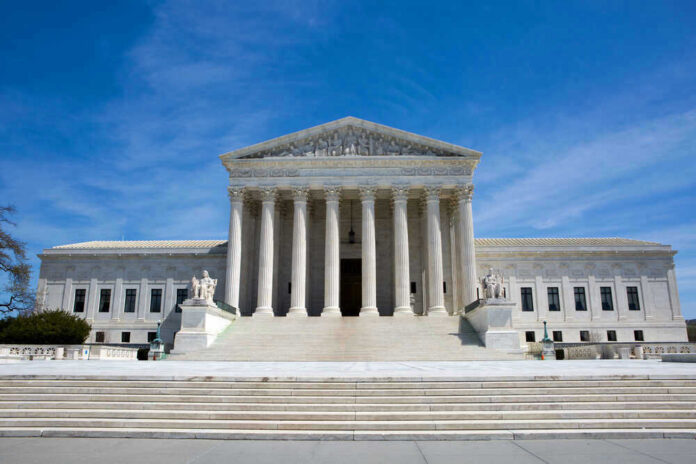
A Supreme Court emergency order just resurrected access to abortion pills nationwide after an appellate court threatened to force millions of women back into doctor’s offices—but the reprieve might last only seven days.
Story Snapshot
- Supreme Court blocked 5th Circuit ruling on May 4, 2026, temporarily restoring telehealth and mail-order mifepristone access nationwide
- Justice Samuel Alito signed the one-week emergency order responding to drugmaker appeals after appeals court reinstated in-person dispensing requirements
- Louisiana’s challenge targets FDA’s 2023 removal of in-person mandates, distinct from 2024 Supreme Court case that upheld mifepristone approval
- Medication abortion accounts for roughly half of all U.S. abortions, with telehealth requests doubling post-Dobbs
- Final Supreme Court decision pending after parties respond within the week, potentially reshaping post-Roe abortion landscape
When Courts Play Ping-Pong With Pills
The whiplash started May 1, 2026, when the 5th Circuit Court of Appeals issued a nationwide order reinstating in-person doctor visit requirements for mifepristone, the drug used in most medication abortions. Within 24 hours, manufacturers GenBioPro and Danco Labs scrambled to file emergency appeals.
By May 4, the Supreme Court hit pause, signing an order that blocks the 5th Circuit’s restrictions for one week while parties submit responses. The temporary restoration means women can again receive prescriptions via telehealth consultations and pills through mail or pharmacies—the very access Louisiana sued to eliminate.
This latest skirmish differs from 2024’s high-profile Alliance for Hippocratic Medicine case, where the Supreme Court preserved FDA approval of mifepristone itself. Louisiana’s lawsuit zeroes in on the FDA’s 2023 rule change eliminating the in-person dispensing requirement—a regulatory tweak the agency justified with safety data showing telehealth outcomes match clinic visits.
The 5th Circuit’s willingness to second-guess FDA science signals a troubling pattern: appellate judges substituting their judgment for career regulators who spent years reviewing evidence. That’s not judicial restraint; that’s judicial activism dressed in pro-life rhetoric.
The FDA’s Science Versus Political Pressure
Mifepristone received FDA approval in 2000, but bureaucrats saddled it with in-person mandates that other medications never faced.
After the COVID pandemic normalized telehealth and requests for remote abortion care doubled following the 2022 Dobbs decision overturning Roe v. Wade, the FDA reviewed the evidence and concluded in 2023 that requiring face-to-face doctor visits served no medical purpose.
Medical research groups concurred: mifepristone administered via telehealth proved just as safe as clinic-based care. The drug works in tandem with misoprostol to end pregnancies through approximately ten weeks gestation, offering an alternative to surgical procedures.
The Supreme Court restored broad access to the abortion pill mifepristone, blocking a ruling that had threatened to upend one of the main ways abortion is provided across the nation. https://t.co/QIwTVdzsGd
— KOB 4 (@KOB4) May 4, 2026
Louisiana and aligned anti-abortion advocates argue the restrictions protect patient safety and prevent doctors from becoming complicit in abortions. Yet the FDA’s data directly refutes safety concerns, and the complicity argument essentially asks courts to override federal drug regulators because state officials dislike abortion.
If jurisprudence means respecting federalism and agency expertise, Louisiana’s lawsuit flunks both tests. States lack authority to dictate FDA approval processes, and judges lack medical credentials to overrule pharmacological evidence.
The Supreme Court’s temporary order at least acknowledges that much, even if Justice Alito’s signature raises eyebrows given his authorship of the Dobbs opinion.
Why This Matters Beyond Abortion Politics
The immediate stakes are clear: medication abortion represents approximately half of all abortions performed in the United States, and telehealth access disproportionately benefits rural women, low-income patients, and residents of states with clinic deserts.
Forcing these women into doctor’s offices imposes travel costs, time off work, and childcare burdens that in-person mandates were designed to create, not eliminate. Democratic-led states have passed shield laws protecting providers who mail pills into ban states, creating a patchwork where ZIP codes determine constitutional rights.
But the long-term implications stretch beyond reproductive rights into the architecture of administrative law. If appellate courts can casually suspend FDA rules based on state lawsuits challenging decades-old safety determinations, what stops activist judges from blocking vaccine approvals, cancer drug protocols, or any pharmaceutical decision that offends political sensibilities?
The pills-by-mail market exceeds one hundred million dollars annually, sustaining telehealth platforms and specialty pharmacies that serve patients across state lines.
Advocates like Elisa Wells of Plan C note that restrictions won’t stop access—women will turn to international suppliers or standalone misoprostol regimens, raising genuine safety concerns the FDA sought to address through regulated telehealth channels.
The Clock Ticking Toward a Bigger Battle
The Supreme Court’s one-week reprieve buys time but guarantees nothing. Parties must now file responses arguing whether the full Court should take up the case or let the FDA’s 2023 rule stand. If the conservative majority sides with Louisiana, millions of women lose telehealth access nationwide, even in states where abortion remains legal.
If the Court affirms FDA authority, it reinforces the principle that scientific agencies, not state attorneys general, govern drug safety.
Supreme Court Restores Access to Abortion Pill Mifepristone through Telehealth, Mail and Pharmacies (AP Photo/Charlie Neibergall, File)
Read the article through the link below! https://t.co/n1ZFppr5LX
— thewyomingtruth (@thewyomingtruth) May 4, 2026
The political fallout will reverberate through 2026 elections regardless of the outcome. Reproductive rights groups frame telehealth as a lifeline jeopardized by extremist courts, while abortion opponents see Louisiana’s challenge as necessary accountability for an FDA they view as captured by pro-choice ideology.
Both narratives miss the deeper question: whether courts exist to substitute judicial preferences for expert judgment, or to defer to regulators absent clear statutory violations. The next seven days will reveal whether the Supreme Court remembers the difference—and whether millions of American women will need a doctor’s appointment to access a pill safer than Tylenol.
Sources:
Politico – Abortion pill telehealth mifepristone Supreme Court
ABC7 Chicago – Supreme Court restores access abortion pill mifepristone telehealth mail pharmacies
Center for Reproductive Rights – 5th Circuit limits telehealth provision of abortion pill