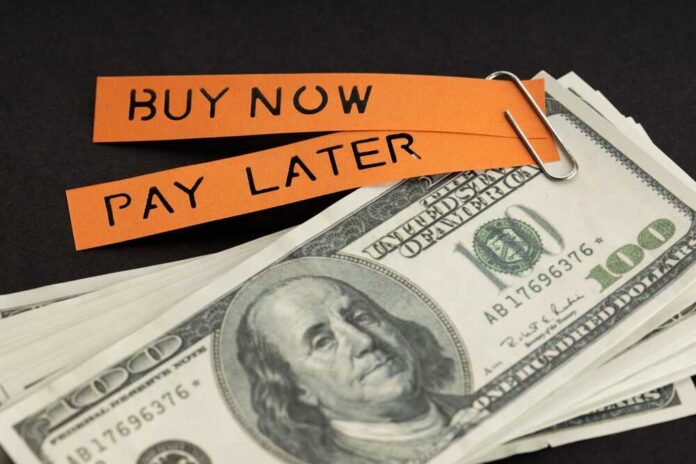
America now finances groceries, rent, and car repairs with “pay-in-pieces” loans designed for sneakers.
Story Snapshot
- The Federal Reserve says 16% of adults used buy now, pay later in 2025.
- Federal Reserve analysts estimate about $160 billion in 2025 originations.
- Surveys show use for rent, groceries, utilities, and medical bills.
- Lenders now market rent-splitting and bill installment products.
BNPL Jumped From Checkout Button To Household Budget Tool
The Federal Reserve reports that buy now, pay later reached 16% of all U.S. adults in 2025, a clear sign the product is mainstream. Federal Reserve analysis estimates close to $160 billion of consumer credit was originated through these plans in 2025, showing real scale, not a fad.
This growth reflects a simple pitch: get what you need now and split the cost into short payments. That model has moved from clothes and gadgets into food, fuel, and rent.
People are turning to BNPL loans to pay for rent, food and other necessities. Now, financial firms are also pushing the loans as a means for people to cover essential expenses. https://t.co/MnD940MaLD
— CBS News (@CBSNews) September 2, 2026
National outlets now document that shift. A July 2026 report found that some users use these loans to pay for rent, groceries, car repairs, and medical care, including 13% of surveyed users who used buy now, pay later to pay rent and 18% who used it for car repairs.
A September 2026 report said lenders are actively pushing these loans for rent, utilities, and medical bills, citing survey data that 23% used them for medical, dental, veterinary costs, or rent. The trendline is clear: essentials are in the mix.
Lenders Are Building For Bills, Not Just Boxes
Product design now targets recurring bills. One major provider launched a pilot that lets renters split monthly payments into two installments through a partnership with a rent platform. Another company offers loans that split rent, utilities, phone, internet, and car payments into smaller parts.
These offers make the timing of bills match the timing of paychecks. That convenience sells. It also changes household math. A late fee that was once a one-off can become a stack of small loans that repeat every month.
Federal Reserve research defines buy now, pay later as a deferred payment arrangement that grants access to goods or services right away while spreading the cost over time.
That framing matters for kitchen-table choices. If the fridge is empty on Tuesday and payday is Friday, a no-interest four-part plan can feel like a bridge.
For families with thin savings, the pitch is powerful. The core question is not whether the product is popular. It is how it is used, how often it is used, and what it replaces.
Why Essentials Are Different From Extras
Groceries and rent are non-negotiable. Using a point-of-sale loan to grab concert tickets is one thing. Using it to feed kids or keep the lights on is another. Surveys show a meaningful share is doing the latter. That signals stress in budgets.
It can also reflect a rational swap from overdraft or payday fees to a structured plan. A mindful reading of household finances favors tools that reduce total costs, reward on-time payments, and avoid hidden traps. Transparency is key.
The numbers deserve plain talk. Sixteen percent adoption means tens of millions of adults used these loans in 2025. One hundred sixty billion dollars of originations means real exposure in credit markets.
If even a modest slice of that goes to rent and bills, then buy now, pay later now shares space with credit cards, utilities payment plans, and landlord late-fee policies. That crossover pulls the product into policy debates on consumer protection and financial stability.
Guardrails Fit The Moment
Clear rules that match the product’s real-world use make sense. Providers who market bill-splitting should disclose total costs, late fees, and consequences in large, simple language. Households should list all active plans on a single page and set autopay from a checking account with a cushion.
Lenders should design hardship paths that pause fees when a job loss hits. These are not big-government asks. They are basic fairness and accountability that reward personal responsibility.
People are turning to BNPL loans to pay for rent, food and other necessities. Now, financial firms are also pushing the loans as a means for people to cover essential expenses. https://t.co/MnD940MaLD
— CBS News (@CBSNews) September 2, 2026
Consumers can adopt a playbook now. Use buy now, pay later for planned essentials only, not impulse buys. Align installments to pay cycles and set calendar reminders. Close old plans before opening new ones.
Compare the plan’s total cost to a credit card with rewards, a utility payment plan, or a landlord’s grace period. If the plan saves money and reduces stress, it earns its spot. If it hides fees or stacks debt, walk away. Simple rules beat clever marketing every time.
Sources:
cbsnews.com, cnbc.com, federalreserve.gov, consumerfinance.gov