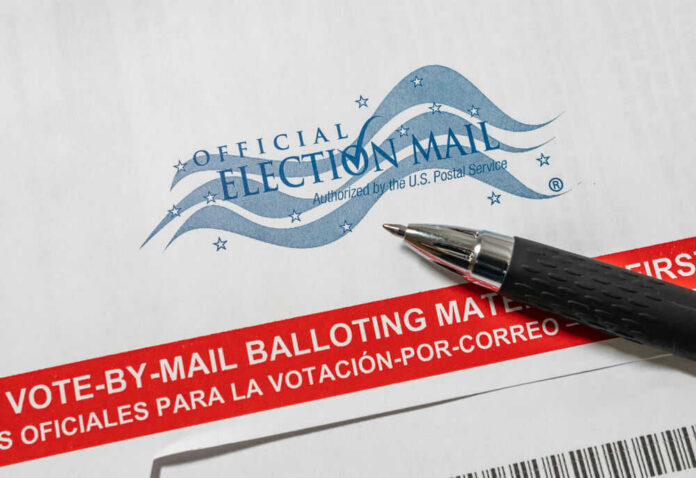
President Trump wants the Supreme Court to let his administration police mail-in voting nationwide before millions of Americans cast midterm ballots this fall.
Quick Take
- President Trump signed an executive order on March 31, 2026, ordering federal agencies to build citizenship lists for state voter rolls.
- The order tells the Postal Service to process mail ballots only for states that hand over eligible-voter lists 60 days early.
- Courts have split, with one judge allowing the order and an appeals court later blocking key parts of it.
- The administration has now asked the Supreme Court to clear the way for full enforcement before the midterms.
What The Executive Order Actually Does
President Trump’s order, titled “Ensuring Citizenship Verification and Integrity in Federal Elections,” directs the Department of Homeland Security and the Social Security Administration to mine federal databases and build lists of adult citizens in every state.
States would then check those lists against their own voter rolls. The order also tells the Postal Service to hold back mail ballots unless a state supplies its list of eligible mail voters at least 60 days before an election.
The Trump administration on Monday asked the Supreme Court to allow it to fully implement an executive order signed by President Donald Trump that seeks to impose additional restrictions on mail-in voting.https://t.co/ZKlX2ZorM5
— SCOTUSblog (@SCOTUSblog) July 27, 2026
The order adds another wrinkle most coverage has glossed over. States must now keep election records, including ballot applications and rejection logs, for five years. Supporters call that a basic audit tool, the kind any well-run business would already have in place. Critics see it as one more federal mandate layered onto state election offices that already run on tight budgets and thin staff.
The Legal Fight So Far
Twenty-three states and the District of Columbia sued almost immediately, arguing the Constitution hands election administration to the states, not the White House. In late May, a federal judge declined to block the order, ruling the challenge was premature since agencies hadn’t finished carrying it out. That was a real win for the administration, even if it wasn’t a ruling on the order’s ultimate legality.
The fight didn’t end there. A Boston-based judge later blocked key parts of the order, and a federal appeals court upheld that block in late July, rejecting the administration’s request to pause the ruling. That left the order enforceable in some states but frozen in the 23 states and Washington, D.C. that sued, a patchwork that satisfies no one and confuses everyone trying to plan for November.
Why The Postal Service Is In The Middle
Turning the Postal Service into a gatekeeper for ballots is the part drawing the sharpest fire. Mail carriers have always been neutral, they deliver what’s addressed to your mailbox. This order asks postal officials to check names against a government-built list before a ballot even reaches a voter, effectively making a delivery agency into an eligibility screener overnight.
That’s a heavy lift for an agency already stretched thin financially. Even backers of citizenship verification should ask whether the Postal Service has the staff, technology, and timeline to pull this off without delays or errors that leave legitimate voters waiting on ballots that never show up.
The Case Now Before The Supreme Court
Facing that split ruling, the administration asked the Supreme Court to let it fully enforce the order everywhere, including the 23 states currently exempt under the injunction. The Justice Department argues the lower courts moved too fast on an order that hadn’t even been fully implemented yet, echoing the same prematurity argument that worked back in May.
Voting rights groups, including the American Civil Liberties Union and the Brennan Center, call the order an illegal power grab dressed up as an integrity measure. Their strongest point is worth taking seriously: no court has yet ruled the order is actually lawful. Every win so far for the administration has been about timing, not substance.
What’s At Stake For The Midterms
Verifying that only citizens vote is a goal most Americans support without hesitation. The open question is whether federal databases built for immigration and Social Security purposes are accurate enough to decide who gets a ballot, a concern raised by multiple outlets covering the rollout. If the lists are sloppy, eligible voters could get flagged by mistake in the middle of a hotly contested midterm cycle.
The Supreme Court’s decision on whether to take up the case, and how fast it moves, will shape mail voting rules in dozens of states just months before Election Day. Election officials, campaigns, and voters alike are now watching the same nine justices to find out which rules actually apply this November.
Whatever the justices decide, the underlying tension isn’t going away. Washington and the states will keep fighting over who really runs American elections long after this particular order is settled one way or another.
Sources:
abcnews.com, politico.com, aclum.org, scotusblog.com, reuters.com, naco.org, votingaccessforall.org