Two massive earthquakes struck Venezuela 39 seconds apart on Wednesday evening, and what happened next echoes a disaster that killed up to 20,000 people in the same country more than two centuries ago.
Story Snapshot
- A 7.2-magnitude quake hit near Venezuela’s Caribbean coast, followed 39 seconds later by an even stronger 7.5-magnitude earthquake, making this one of the strongest seismic events ever recorded in the country.
- Buildings collapsed in Caracas, entire walls fell away exposing furniture to the street, and Venezuela’s main international airport was damaged badly enough to force its closure.
- The U.S. Geological Survey (USGS) issued a rare red alert warning of potential mass casualties and severe economic losses, while a tsunami warning was briefly triggered for Puerto Rico and the U.S. Virgin Islands.
- Venezuela’s acting President Delcy Rodriguez confirmed damage across multiple states but released no casualty figures, leaving the full death toll unknown in the immediate aftermath.
Two Earthquakes, 39 Seconds Apart, Changed Everything
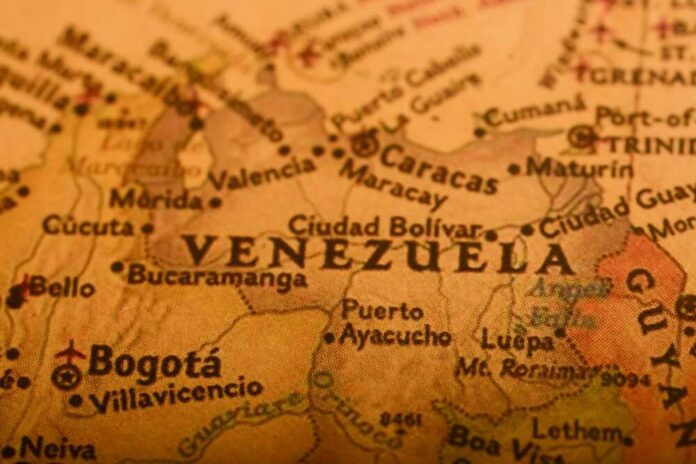
Shortly after 6 p.m. on Wednesday, a 7.2-magnitude earthquake struck near the community of Morón, along Venezuela’s Caribbean coast, about 168 kilometers west of Caracas. The quake hit at a depth of 22 kilometers.
Before most people could even process what was happening, a second, stronger 7.5-magnitude earthquake followed just 39 seconds later, centered 16 kilometers southwest of Morón at a depth of only 10 kilometers.
The USGS called it a seismic doublet, an extremely rare back-to-back pairing where the first quake acts as a foreshock to an even bigger event. [6]
The shallow depth of the second quake matters enormously. The closer a quake is to the surface, the more violent the shaking above it. A 10-kilometer-deep quake delivers far more destructive energy to buildings than a deeper one of the same magnitude. That physics showed up immediately in Caracas. Residents fled swaying buildings.
Entire walls collapsed, leaving furniture exposed to the open street. Dust columns rose over at least two neighborhoods. Eyewitnesses described glasses flying off shelves and neighbors screaming in the streets. [1]
The Airport Closed, People Were Trapped, and the Capital Lost Power
Acting President Rodriguez confirmed the earthquakes damaged Simon Bolivar International Airport badly enough to shut it down. Classes were canceled for several days. In the state of Falcon, Governor Victor Clark reported 32 people hospitalized, with 15 still trapped more than four hours after the quakes struck.
Parts of Caracas lost both power and cellphone signal. Interior Minister Diosdado Cabello went on state television and confirmed collapsed homes and buildings in the Altamira neighborhood. Emergency crews began digging through rubble. [6]
BACK-TO-BACK QUAKES: A powerful 7.1-magnitude earthquake followed by a 7.5-magnitude quake shook Venezuela on Wednesday, collapsing buildings in the capital of Caracas and causing injuries. Tsunami alerts and warnings were issued in the area. https://t.co/4pIwxrfWoa pic.twitter.com/iFDsiIlEsR
— ABC7 Eyewitness News (@ABC7) June 25, 2026
The tremors were felt far beyond Venezuela’s borders. Buildings were evacuated in Colombia. In Brazil’s Amazon region, roughly 1,700 kilometers away, structures in the cities of Manaus, Belem, and Macapa were cleared out.
A tsunami warning briefly covered Puerto Rico, the U.S. Virgin Islands, and the British Virgin Islands before authorities canceled it. The scale of the seismic energy released was staggering by any measure. [9]
The USGS Red Alert and the Casualty Uncertainty That Followed
The USGS issued a rare red alert, its highest warning level, signaling the potential for very high casualties and severe economic losses. Early projections suggested casualties could reach into the thousands. But hours after the quakes, Venezuelan authorities had released no official death toll.
The Miami Herald reported that Venezuela’s official seismic monitoring agency, the Venezuelan Seismological Research Foundation, had not yet released a final report on magnitude, depth, or exact location. [3] That silence created a vacuum that conflicting early reports quickly filled.
A rescuer looks at the rubble of a collapsed building following an earthquake in Caracas on June 24, 2026. Two earthquakes of magnitude 7.2 and 7.5 struck the same area of Venezuela on the evening of June 24, causing buildings to collapse, according to the United States… pic.twitter.com/uoDbFHnIEI
— ABS-CBN News (@ABSCBNNews) June 25, 2026
One NBC News reporter stated, about an hour after the quakes, that there were no confirmed reports of collapsed buildings. That claim aged poorly. Eyewitness video, statements from Venezuela’s own interior minister, and footage from the Altamira neighborhood all showed clear structural failures.
The early contradiction between on-the-ground accounts and some initial media reports reflects a pattern common in major disasters: official data lags behind reality, and reporters working remotely sometimes miss what people standing in the rubble can plainly see.
This Has Happened Before, and the History Is Sobering
Venezuela is not typically considered high earthquake country. Global hazard models classify Venezuela’s earthquake risk as very low, with less than a 2% chance of damaging shaking over a 50-year period. [10] But that statistical comfort means little when a fault line decides to move.
The last time Venezuela experienced something close to this was 1812, when a 7.7-magnitude earthquake struck Caracas on Maundy Thursday, killing an estimated 15,000 to 20,000 people. Historians note that event also involved two distinct seismic shocks, one destroying Caracas and a second striking Merida. [11] Wednesday’s doublet drew immediate comparisons to that catastrophe.
The 2026 quakes rank among the strongest ever instrumentally recorded in Venezuela. The combination of shallow depth, back-to-back timing, an already fragile urban infrastructure in Caracas, and a government with a history of slow information release created a dangerous mix.
The full picture of lives lost and buildings destroyed will take days to emerge. What is already clear is that Venezuela absorbed a seismic punch it had not felt in more than a century, and the country is only beginning to count the cost.
Sources:
[1] YouTube – Back-to-back earthquakes hit Venezuela and collapse buildings in …
[3] Web – Tens of thousands feared dead and chaos as powerful earthquakes …
[6] Web – A magnitude 7.1 earthquake struck Venezuela on Wednesday, the …
[9] Web – Venezuela earthquake: buildings collapse in Caracas after … – BBC
[10] Web – 7.1-magnitude earthquake rattles Venezuela – NBC News
[11] Web – Venezuela earthquakes live blog: At least 32 people killed and 700 …