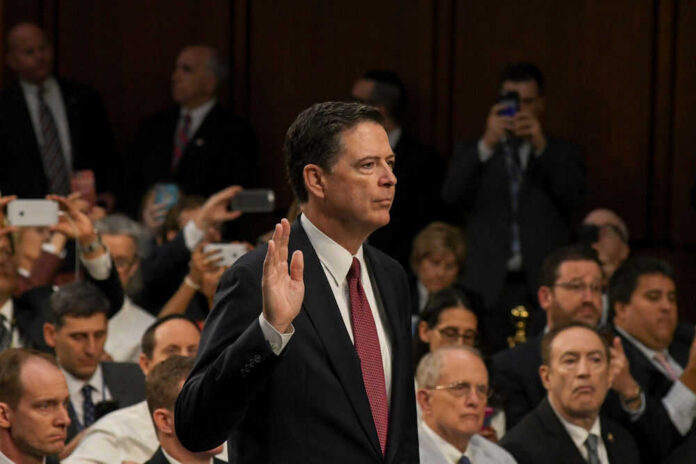
Federal prosecutors filed new criminal charges against former FBI Director James Comey for the third time, accusing him of leaking national defense secrets a decade ago.
Story Snapshot
- The Justice Department filed a criminal information on October 5, 2026, in federal court in Washington, D.C.
- Comey faces charges of transmitting national defense information and conspiring to transmit it.
- The alleged conduct dates back to October 2016, when Comey led the FBI.
- Comey calls the charges false and says he remains unafraid to fight them.
A Third Criminal Case Lands on Comey’s Desk
This marks the third time the Justice Department has brought criminal charges against Comey since he left the FBI. News outlets including CNN and UPI reported the filing as part of a pattern that has made Comey a recurring target of federal prosecutors under President Trump’s administration. The new case centers on national defense information, a different legal theory than earlier matters involving congressional testimony and social media posts.
What the New Charges Actually Allege
The charging document accuses Comey of directing someone else, described as a co-conspirator, to hand national defense information to a reporter at a national news outlet. Prosecutors tie the alleged act to October 4 and 5, 2016, when Comey still ran the FBI. A separate court filing from Comey’s own lawyers connects the allegation to a New York Times story published on October 5, 2016.
The public charging papers do not name the reporter, the publication, or the specific document allegedly shared. They also do not identify the person Comey is accused of directing. Those gaps leave much of the alleged chain of events undisclosed, though the core charges themselves are stated clearly in the filing now sitting before the court.
Comey Fires Back With a Public Statement
Comey responded in a video posted to his Substack page. “They’re back again,” he said, adding, “I’m still innocent. I’m still not afraid of these people, and I still believe in the independent federal judiciary.” The statement echoed his earlier public posture during previous legal fights with the current Justice Department.
Comey’s attorney, Patrick Fitzgerald, pushed back harder in a statement to reporters. He said prosecutors in two separate administrations already investigated the same conduct over the past decade and found no basis for charges. Fitzgerald specifically noted that during President Trump’s first term, the Justice Department concluded “no charges should be brought against anyone” over the matter now revived.
The Legal Fight Over Timing
The filing landed just before the ten-year anniversary of the alleged 2016 conduct, a timing detail that has drawn attention from legal reporters. Prosecutors used a criminal information rather than a grand jury indictment, a procedural choice that raises questions about whether the filing properly preserved the case before the statute of limitations expired. Reports indicate the Justice Department still intends to pursue a grand jury indictment next.
DOJ Charges James Comey Third Time Over 2016 Leak Allegation
Federal prosecutors unsealed a criminal information Monday charging former FBI Director James Comey with transmitting and conspiring to transmit national defense information.
The two counts stem from an alleged… pic.twitter.com/a6BRbvyyDg
— American Voice Rising (@amvoicerising) October 27, 2026
That procedural detail matters because statutes of limitations exist to force the government to act on known evidence within a set window. Whether a prosecutor-filed information satisfies that requirement, without a grand jury’s involvement, is now a live legal question for the court to resolve before the case can move forward.
The Espionage Act’s Long and Blurry History
The charges rely on the Espionage Act, a World War One-era law that never actually uses the word “classified.” It instead bans transmitting national defense information with a specific guilty state of mind, which is a narrower and harder legal target than simply mishandling marked documents. That distinction has mattered in court for over a century.
Federal leak prosecutions under this law expanded sharply after the September 11 attacks. Reuters counted twelve Espionage Act leak cases through 2017, and eight of those happened during the Obama administration. Comey’s case now joins that long list, giving prosecutors a well-worn legal path but also a history full of fights over what truly counts as national defense information.
Americans who value the rule of law should want this case judged on hard evidence, not headlines. A sitting administration charging a former FBI director demands real proof of intent and real proof the information mattered to national security. Due process applies to Comey exactly as it applies to anyone else, and the court record will ultimately decide whether these charges hold up.