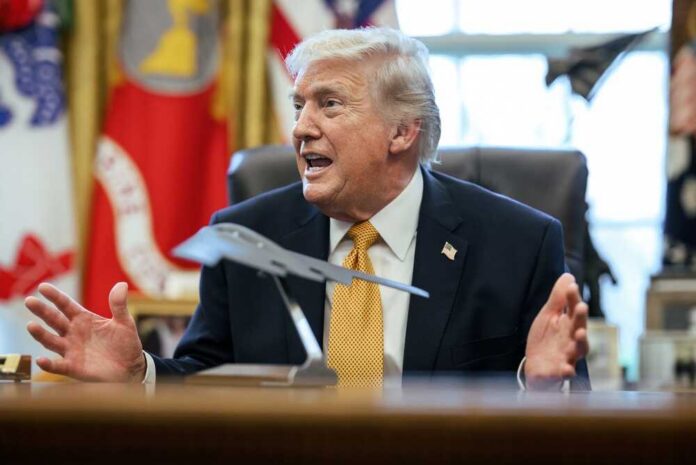
BREAKING UPDATE: TRUMP HAS CANCELED TODAY’S CAMP DAVID MEETING AND WILL HOLD IT AT THE WHITE HOUSE.
When a president calls his entire foreign policy team to Camp David on short notice, something serious is either happening or about to happen — and right now, that something is Iran.
Story Snapshot
- President Trump convened a rare Cabinet meeting at Camp David as U.S.-Iran nuclear negotiations reached what officials described as a critical phase.
- Trump’s entire top foreign policy team huddled for hours to discuss strategy on the Iran nuclear crisis and the ongoing war in Gaza.
- Reports surfaced that the U.S. and Iran were nearing a broader peace agreement following months of conflict and stalled talks.
- The meeting followed U.S. military strikes on Iran that the administration characterized as acts of self-defense.
Why Camp David Changes the Atmosphere in the Room
Camp David is not a conference center. It is the president’s country retreat, a place deliberately removed from the noise of Washington, and its use carries unmistakable weight. Since Winston Churchill became the first foreign dignitary to meet a sitting American president there, the address has functioned as a signal — not just a setting. When a president moves his Cabinet to that location, he is telling everyone in the room, and everyone watching, that the conversation demands a different level of seriousness.
President Trump is expected to take the unusual step of holding a Cabinet meeting at Camp David on Wednesday, The Washington Times has confirmed. https://t.co/CDCGgU4fnr
— The Washington Times (@WashTimes) May 26, 2026
Trump convened his full Cabinet at Camp David with his entire top foreign policy team present for hours of strategy discussions focused on the Iran nuclear crisis and the war in Gaza. That is not a routine scheduling decision. Presidents do not haul their Cabinet secretaries out of Washington on a weekday without a compelling reason, and the reason here was plainly visible: negotiations with Iran had entered a phase where the next move could define the outcome of the entire diplomatic effort.
The Diplomatic Timeline That Made This Meeting Necessary
The backstory matters. Trump had set a 60-day deadline for Iran to reach a nuclear agreement. When that deadline passed without a deal, Israel launched a series of strikes against Iran. The United States subsequently conducted its own military operations, which the administration framed as self-defense.
By late May 2026, reports indicated the two countries were nearing a broader peace agreement after months of conflict and collapsed negotiations. That arc — deadline, military escalation, and then a possible off-ramp — is exactly the kind of compressed timeline that demands a face-to-face Cabinet-level reckoning.
Trump publicly described the talks as proceeding “nicely,” which is either genuine optimism or deliberate strategic messaging designed to keep the Iranian side at the table. Given the military activity that preceded these talks, the optimistic framing is not naive — it is calculated. Projecting confidence in a negotiation you want to close is a basic tool of deal-making, and Trump has used it throughout his political career with varying degrees of success. The question now is whether the Iranians read it the same way.
What the Venue Proves and What It Does Not
Skeptics have a fair point: Camp David’s symbolic weight does not automatically confirm a policy breakthrough. The White House itself notes the retreat has hosted foreign dignitaries for decades, and a presidential meeting at a historic location tells you that something important is being discussed, not necessarily that it has been resolved.
No official agenda or decision readout was published. The meeting’s significance rests, for now, on the venue, the timing, the personnel in the room, and the context of active military and diplomatic pressure on Iran.
Trump to convene rare Camp David Cabinet meeting amid rising Iran tensionshttps://t.co/30R04msxcO
— ABC 33/40 News (@abc3340) May 26, 2026
That said, the convergence of factors here is not nothing. An unscheduled trip, a full Cabinet present, a multi-hour session, airspace restrictions over the facility, and an active negotiation with a nation the U.S. had recently struck militarily — that combination goes well beyond a symbolic photo opportunity.
The administration was working something specific, and the Iran file was at the center of it. Whether a formal deal materializes or the talks collapse again, this meeting marks a genuine inflection point in one of the most consequential foreign policy situations of Trump’s second term.
The Larger Stakes No One Should Miss
A nuclear-capable Iran is not an abstract threat. It reshapes the entire Middle East security architecture, puts American allies at existential risk, and hands adversaries a leverage point that cannot be easily undone. The Camp David meeting signals that the Trump administration understands the window for a negotiated outcome may be narrow.
Getting this right matters enormously — not just for the region, but for American credibility as a nation that can both apply military pressure and close a deal when the terms are right. That combination, strength followed by diplomacy, is exactly what common sense and American interests demand.
Sources:
[1] Web – Trump calls rare Camp David Cabinet meeting amid critical Iran talks
[2] Web – 2025–2026 Iran–United States negotiations – Wikipedia
[3] Web – Camp David – The White House
[4] Web – Trump to hold Cabinet meeting at Camp David on Wednesday
[5] Web – Trump discussed Gaza, Iran goals at Camp David strategy session