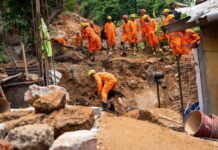
A blast that tore through a building has left a grisly question hanging over the rubble: were people living beside a storage site for mining explosives, or did the fireball expose something even more dangerous?
Quick Take
- Rescuers and syndicated reporting say the explosion killed more than 45 people and injured dozens more.[1][2][3]
- The building was described as a place storing explosives for mining, not an ordinary structure.[2][3]
- The blast occurred in Kong Tube Village, Namkham Township, near the Chinese border.[1]
- No source in the package establishes the cause, so the central fact remains the scale of the disaster, not the mechanism.[1][2][3]
The Blast That Turned a Storage Site Into a Mass Casualty Scene
The reporting is strikingly consistent on the basic outline: a blast hit a building in Myanmar said to have been storing explosives for mining, and the death toll climbed past 45.[2][3] Times of India reported around 70 injured, while rescue-worker accounts cited 46 bodies recovered, including children.[1] That combination of a high body count and an explosives-storage setting is what makes this case more unsettling than a generic explosion. It points less to random destruction than to a dangerous industrial setup collapsing into civilian tragedy.[1][2][3]
Location matters here because it narrows the kind of scrutiny that should follow. The blast was reported in Kong Tube Village, Namkham Township, in northeastern Myanmar, roughly two miles from the Chinese border.[1] That matters because borderland conflict zones often have fragmented oversight, thin reporting, and delayed verification. The first facts that surface in such places usually come from rescuers, not regulators. In this case, that means the public knows what happened before it knows why it happened.[1][2][3]
What the Reporting Supports, and What It Does Not
The strongest supported claim is simple: people died in large numbers at a place described as storing explosives for mining.[2][3] The weaker claim is anything beyond that. None of the available reports identify an ignition source, a responsible party, or a formal safety failure.[1][2][3] That is an important distinction. A site can be deadly without immediately proving negligence, sabotage, or attack. In a sober reading, the evidence supports a disaster at an explosives-storage location, not a completed explanation for the blast.
Blast at a building in northeastern Myanmar, reportedly storing explosives for mining, has killed more than 45 people – rescuers pic.twitter.com/vsfFkLw5cJ
— TRT World Now (@TRTWorldNow) May 31, 2026
The casualty numbers themselves are enough to tell a grim story. Rescue-worker reporting said 46 bodies were recovered, including six children, and that 74 injured people were taken to hospital.[1] Other outlets described more than 45 dead and around 70 injured.[1][2][3] When separate reports converge that closely, the broad scale becomes credible even if the finer details remain unsettled.
That convergence is the reason this incident has drawn attention beyond the immediate region: the human toll is too large to treat as a routine industrial accident.
Why the Cause Still Matters More Than the Headline Number
The unresolved issue is not just academic. If the building held mining explosives, then storage practices, access control, inventory records, and site security become the real story.[2][3] Those are the questions that determine whether this was a preventable accident, a chain-reaction event, or something else entirely.
Yet the source set contains no official statement from Myanmar authorities or the operator, and no forensic analysis of blast patterns, residue, or structural failure.[1][2][3] That silence leaves the public with a powerful headline and a weak explanation.
Conflict-affected areas tend to reward speculation faster than proof, and this case fits that pattern.[1][2][3] Early coverage emphasizes deaths, injuries, and the description of the site, which can harden public assumptions before investigators have a chance to test them. That is exactly why the next useful step is not more dramatic language but harder evidence: licensing records, storage permits, eyewitness testimony, hospital logs, and pre- and post-blast imagery. Until then, the facts support grief, not certainty.
Sources:
[1] Web – Rescuers say a blast at a building storing explosives in Myanmar has …
[2] Web – More than 45 killed, around 70 injured in blast at explosives storage …
[3] Web – More than 45 people killed in blast at building storing explosives in …