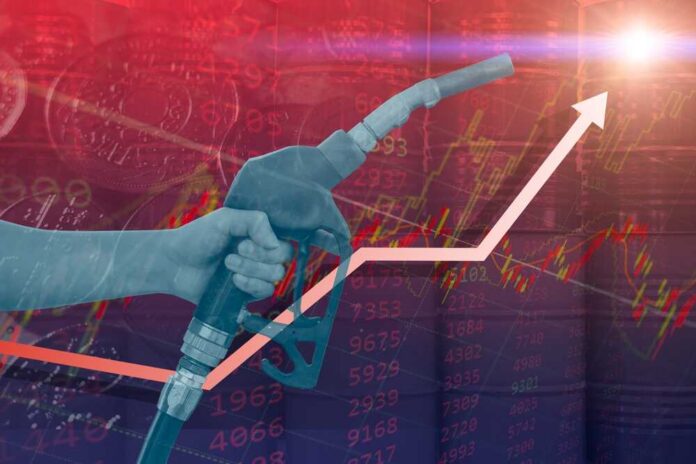
Four-dollar gas is back in America, not because you drove more, but because missiles flew over the world’s main oil choke point and traders decided you would pay for it.
Story Snapshot
- U.S. average gas price has climbed back to about $4 a gallon as the Iran war reignites.
- A fresh U.S. naval blockade and new Iranian attacks around the Strait of Hormuz are choking global oil flows again.
- Gas was already painfully high from months of war-driven oil spikes and refinery problems before this latest jump.
- Media and politicians blame Iran almost alone, while other supply and policy choices quietly add fuel to the fire.
How America Ended Up Back At Four-Dollar Gas
American drivers woke up to see the national average back at roughly $4 a gallon, a level not seen in years before the Iran war started. This did not happen in a single night. Prices had already climbed more than a dollar a gallon since the first U.S. and Israeli strikes on Iran in late February, a jump of roughly one-third.
By late March, GasBuddy data and the American Automobile Association showed the average crossing $4 for the first time in over three years, breaking a psychological line for millions of families.
After a short spring ceasefire and talk of a deal, prices eased a bit and even dipped below $4 in June as fears over supply improved. Many people thought the worst had passed. Then the deal fell apart, fighting flared again, and a new push of U.S. and Iranian attacks slammed into the same fragile energy system.
That renewed conflict pressure, layered onto already tight supplies, explains why the average cost at the pump has jumped back up toward $4 nationwide instead of drifting lower.
The Strait Of Hormuz: A Narrow Channel, A Huge Bill
The real action is not at your corner gas station. It is in the Strait of Hormuz, the narrow waterway off Iran that carries about one fifth of the world’s oil and gas.
Iran’s earlier attacks and drone strikes near Gulf shipping lanes forced oil companies to slow or reroute tankers, while U.S. naval blockades and threats of more strikes turned a crowded highway for oil into something close to a single-lane road.
Analysts describe tanker traffic in some periods as falling to a “trickle,” which means fewer barrels can reach refineries and markets on time.
BREAKING: U.S. gas prices have jumped to an average of $4 a gallon again as the U.S. and Iran launch more attacks. https://t.co/axKon9Fysc
— The Associated Press (@AP) July 20, 2026
When less oil moves through that channel, global benchmark prices jump fast. Brent crude surged more than 50 percent during the first phase of the war, hitting peaks near $120 a barrel. That rise pulls up U.S. crude prices and, in turn, the cost of gasoline.
Experts call this a “war risk premium” on oil, often in the range of $5 to $15 per barrel, which then shows up at the pump within days or weeks. The latest round of strikes and renewed blockade threats pushed oil higher again, putting fresh upward pressure on U.S. fuel prices just as drivers hoped for relief.
Beyond The Battlefield: Refineries, Rules, And Media Spin
War is not the only reason you are paying more, even if television headlines say so. Refinery outages inside the United States have cut the ability to turn crude into gasoline and diesel, tightening supply further and driving prices up alongside the Iran conflict.
Seasonal demand and holiday travel add extra strain, but they rarely get blamed when reporters can point to dramatic missile footage instead. This narrow focus lets political leaders dodge questions about domestic capacity, regulations, and long-term planning that also shape your gas bill.
Some voices in Washington strike a tone that feels out of touch. Secretary of State Marco Rubio brushed off the pain at the pump, saying the country is “very fortunate” even as average prices neared $4.50 a gallon earlier in the war.
President Trump has assured Americans that prices will fall once the Iran war ends, yet data through late April showed costs still rising after a ceasefire, not dropping.
From a common-sense view, this gap between upbeat talk and hard numbers matters. Families live in the real world of grocery receipts and gas charges, not press lines that treat four-dollar fuel as a mere inconvenience.
Who Really Benefits From War-Driven Energy Panic
Financial markets rarely waste a crisis. Oil futures traders and some energy analysts make money from sharp swings in prices, and war headlines are perfect fuel for volatility.
Reports show strategists pricing in extra “risk premiums” of well over $10 per barrel after major attacks, based on fear that flows through the Strait of Hormuz could suddenly stop.
These higher premiums turn into short-term profit for those positioned correctly in the market, while ordinary drivers face weeks or months of elevated fuel bills for commuting and basic errands.
US gas prices hit an average of $4 a gallon again as the US and Iran launch attacks https://t.co/AqAPtpYBE8
— The San Diego Union-Tribune (@sdut) July 20, 2026
Media coverage often amplifies worst-case scenarios, giving front-page space to predictions of $5 or even $7 gas if the strait stays blocked. Many stories present those numbers as likely outcomes rather than conditional risks.
That framing helps justify high prices and deflects blame from policy decisions at home, including how many refineries operate, how regulations affect supply, and whether government steps like lifting ethanol rules or waiving shipping laws truly help consumers.
From a practical standpoint, the key is simple: recognize foreign threats are real, but do not ignore how domestic choices and market incentives decide how big your final bill becomes.
Sources:
apnews.com, cnbc.com, wsj.com, bostonglobe.com, theguardian.com, foxbusiness.com, time.com, aljazeera.com, reuters.com, thehill.com, nytimes.com, bushcenter.org