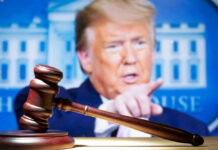
A nearly 30-year-old encounter in a department store dressing room just ended with a president ordered to hand over $5.8 million, and the system itself is now on trial in the court of public opinion.
Story Snapshot
- A federal jury found President Trump liable for sexually abusing and defaming writer E. Jean Carroll.
- The jury awarded $5 million; with interest, a judge has now ordered $5.8 million released to Carroll.
- Trump’s appeals up through the Supreme Court failed, but his team still attacks the trial as unfair.
- The case shows how modern defamation and sex abuse law treats powerful public figures without physical evidence.
How a decades-old claim turned into a multi-million dollar judgment
The story starts in the mid-1990s, in the Bergdorf Goodman department store in Manhattan. Carroll said Trump pushed her into a dressing room, forced himself on her, and attacked her sexually. She kept quiet publicly for years. When Trump became president and later denied her claims as a “hoax,” she responded the way the law allows: she sued for battery and defamation in federal court in New York.
After a nine-day trial, a jury of ordinary citizens listened to Carroll’s testimony, Trump’s denials, and evidence from other women and the now-famous Access Hollywood tape. The jurors decided Trump sexually abused Carroll and defamed her in 2022 statements, but they did not find rape as New York’s penal code defines it.
They awarded her $5 million in total damages: money for the sexual abuse, money for the defamation, and punitive damages meant to punish and deter.
Writer E. Jean Carroll can collect $5.8 million awarded to her after a jury found that President Donald Trump sexually abused and defamed her, a federal judge ruled Wednesday. MORE: https://t.co/ixCAMJ46kg pic.twitter.com/3hgyli7kQ8
— NEWSMAX (@NEWSMAX) July 8, 2026
What the jury actually found Trump did
The trial record matters because it cuts through a lot of noise. The jury’s finding of sexual abuse was based on a specific act: that Trump forcibly penetrated Carroll with his fingers, what the court later described as digital penetration. Under New York law, that is sexual abuse.
The judge explained that the evidence showed real physical and emotional trauma and that the damages award was reasonable for that harm.
On defamation, the jury found that Trump’s 2022 statements calling Carroll’s story false and a hoax crossed a legal line. For defamation, the law looks for false statements of fact that damage someone’s reputation.
The jury decided Trump’s statements were false and harmful, and that he made them knowing they were false or with reckless disregard, which is the “actual malice” standard public figures must prove.
Why appeals failed and the money is now being released
Trump did not stop at the trial. His legal team argued on appeal that the judge allowed “indefensible” evidence that prejudiced the jury.
They complained about testimony from other women and the Access Hollywood recording, saying that material painted Trump as a bad man instead of focusing only on Carroll’s claim. They said the trial court twisted federal evidence rules on sexual assault cases.
The United States Court of Appeals for the Second Circuit reviewed those complaints and rejected them. The panel held that the trial judge acted within the rules, including federal rules that allow evidence of other sexual assaults to show a pattern when sexual assault is alleged.
The appeals court affirmed the judgment and kept the full $5 million award. Trump then tried the last door: the Supreme Court of the United States.
The Supreme Court’s quiet but decisive answer
The Supreme Court declined to hear Trump’s appeal. That might sound passive, but it is powerful. When the high court refuses a case, the lower court ruling stands. In this situation, it meant the 2023 jury verdict and $5 million civil judgment were final.
One of Carroll’s lawyers said the decision confirmed the jury’s unanimous finding that Trump sexually assaulted and defamed Carroll and ended his efforts to dodge accountability.
Trump asks Supreme Court for rehearing over $5M E Jean Carroll civil judgment | Eric Mack, Fox News
President Donald Trump’s lawyers asked the Supreme Court to reconsider its decision rejecting his appeal of the $5 million civil judgment awarded to writer E. Jean Carroll, a… pic.twitter.com/1uRkVrJ78b
— Owen Gregorian (@OwenGregorian) July 9, 2026
Finality opened the door to money. Trump had already placed the $5 million in escrow while the appeals played out. With interest, the total grew to about $5.8 million.
A federal judge, Lewis Kaplan, then ordered that entire amount released to Carroll, ruling she could collect immediately because the Supreme Court’s rejection cleared the legal roadblock. Trump’s lawyers appealed that release order as well, trying to slow the payment even after losing on the core case.
Sex abuse, defamation, and concerns about fairness
This case hits several nerves for anyone who worries about politicized justice. There is no physical evidence from 1996, no medical records, and no third-party witness from that night.
The jury had to choose whose story to believe almost 30 years later. Trump’s supporters say that opens the door for weaponized accusations against political enemies. They also see New York City as a hostile venue and point to the use of old recordings and other accusers as proof of bias.
Yet the legal structure cuts both ways. Modern defamation law makes it hard for public figures to win; they must show actual malice, which protects robust political speech but also limits recourse when statements are truly false. Here, the system worked against a powerful man.
Three levels of courts, including the Supreme Court’s refusal to intervene, let the jury’s decision stand. From a common-sense view, that raises a tough tension: distrust of elite institutions versus respect for a jury of citizens doing its job.
What this means for future fights over speech and power
Carroll’s win will encourage other accusers and defamation plaintiffs to challenge high-profile figures who, in their view, hide behind fame and politics. Big verdicts and real payouts show defamation law is not just theory; it can hit powerful people in the wallet.
At the same time, the lack of physical evidence and the heavy focus on credibility will keep fueling skepticism and fears of politically driven cases.
For anyone watching from the right, the lesson is double-edged. Juries still matter. Facts, testimony, and trial advocacy still matter. But when politics and culture wars wrap around a civil case, the line between legal accountability and political punishment can look very thin.
The Carroll judgment, and now the $5.8 million order, sits right on that line and guarantees this fight over sex, speech, and power is not going away.
Sources:
apnews.com, en.wikipedia.org, law.justia.com, instagram.com, facebook.com, latimes.com, pbs.org, youtube.com