President Trump’s renewed threat to fire Federal Reserve Chair Jerome Powell is turning a wonky fight over interest rates into a high-stakes test of who really runs America’s money—and whether politics can shove aside guardrails.
Story Snapshot
- Trump said he would fire Fed Chair Jerome Powell if Powell does not leave when his term as chair ends May 15, even if a successor is not yet confirmed.
- The confrontation is entangled with a DOJ probe tied to Federal Reserve headquarters renovations, a probe that judges have recently blocked due to a stated lack of evidence.
- Trump’s nominee to replace Powell, Kevin Warsh, faces a Senate confirmation process complicated by the ongoing dispute.
- Markets and borrowers could face uncertainty if a leadership gap or legal fight erupts over the Fed’s independence and authority.
Trump’s May 15 deadline turns a personnel dispute into a constitutional-style clash
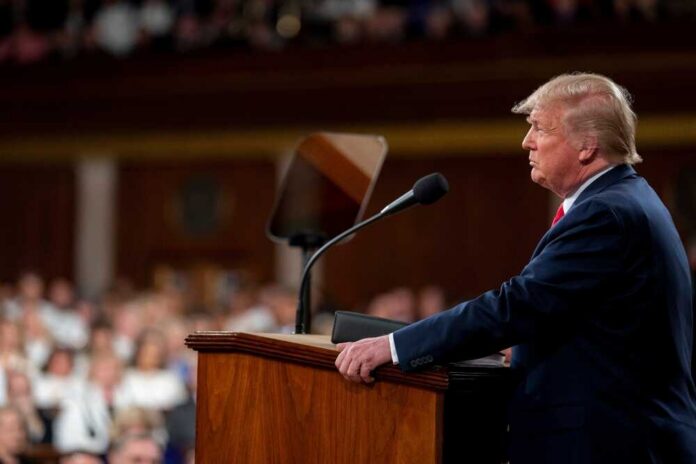
President Trump told Fox Business’s Maria Bartiromo that if Jerome Powell does not leave when his term as Federal Reserve chair ends on May 15, “then I’ll have to fire him.” The threat matters because Trump suggested he would act even if the Senate has not confirmed his preferred replacement, Kevin Warsh.
That combination—an approaching term deadline, a pending confirmation, and a firing threat—creates real uncertainty about who is empowered to lead the central bank day to day.
President Trump says he will fire Fed Chair Jerome Powell if Mr. Powell doesn't leave by May 15. A criminal probe and a defiant senator are making that easier said than done. https://t.co/9o267TvQX6
— The Washington Times (@WashTimes) April 15, 2026
Rules and precedent around Federal Reserve leadership exist to keep monetary policy from becoming a short-term political lever. Powell can remain on the Fed’s Board of Governors after his chair term ends, and reporting indicates arrangements could allow him to continue in a temporary chair capacity if a successor is not in place.
Trump’s public posture, however, signals a willingness to force the issue. That sets up a scenario where the fight is not just about one official, but about the durability of institutions.
The DOJ renovation probe adds heat, but court rulings raise questions about its strength
The immediate spark for this round of escalation is a Justice Department criminal probe into Powell connected to the Federal Reserve’s headquarters renovation project and Powell’s testimony about it.
Recent developments have undercut the investigation’s momentum: Chief Judge James Boasberg blocked DOJ subpoenas and described the evidentiary showing as “essentially zero,” and the DOJ also lost a bid to revive the subpoenas. Those court outcomes complicate narratives that the probe is driving toward a clear legal conclusion.
Even so, the conflict has not cooled. Reporting says DOJ prosecutors from U.S. Attorney Jeanine Pirro’s office made an unannounced visit to the renovation site and were turned away.
Powell has publicly said he has “no intention” of leaving until the investigation is “well and truly over,” a stance that effectively dares political leadership to either wait or escalate. When an investigation is both politically charged and legally constrained, the result is often a long, noisy stalemate rather than clarity for the public.
Kevin Warsh’s confirmation becomes a leverage point inside a GOP-controlled Washington
Trump’s preferred successor, Kevin Warsh, is moving through the Senate’s confirmation pipeline, with a hearing date reported for April 21. Yet even in a Republican-controlled Senate, confirmation can become a pressure valve for concerns about stability, process, and timing.
One reported complication is that Sen. Thom Tillis has signaled opposition to Warsh until the Powell probe is resolved. That posture underscores that GOP control does not automatically mean frictionless execution, especially when institutional credibility is at stake.
Why interest rates and debt costs sit behind the rhetoric—without settling the independence question
Trump’s longstanding frustration with Powell centers on interest rates and the belief that the Fed has been too resistant to rate cuts. A Harvard Kennedy School analysis argues the deeper motivation is cheaper debt financing: lower rates reduce federal debt-service costs, especially as Washington contemplates trillions in additional debt.
That argument helps explain the intensity of the clash, but it also highlights a tension many voters across the spectrum feel—leaders want relief from high costs, yet weakening monetary guardrails can carry inflation and credibility risks.
For conservatives who want accountable government, the Powell fight is a reminder that “independent” agencies can still become arenas for political warfare. For liberals worried about executive overreach, the firing talk raises alarms about precedent and politicizing monetary policy.
For everyone else trying to afford groceries, housing, and credit-card interest, the practical concern is simple: leadership turmoil at the Fed can rattle markets and expectations. The available reporting does not prove an imminent legal outcome—only an intensifying power struggle with real-world consequences.
Sources:
Trump Threatens to Fire Fed Chair Jerome Powell Before His Time Is Up.
DOJ surprise visit to Fed deepens clash over Powell probe
The real reason Trump wants to fire the Fed chair